Role
Software Developer · R&D
Selected work · 02
An AI-led hiring pipeline: résumé and job-description parsing, a real-time voice interview agent, and structured reports that let a recruiter review a candidate in minutes instead of sitting through every interview.
Python · real-time voice AI · LLMs · speech-to-text / text-to-speech
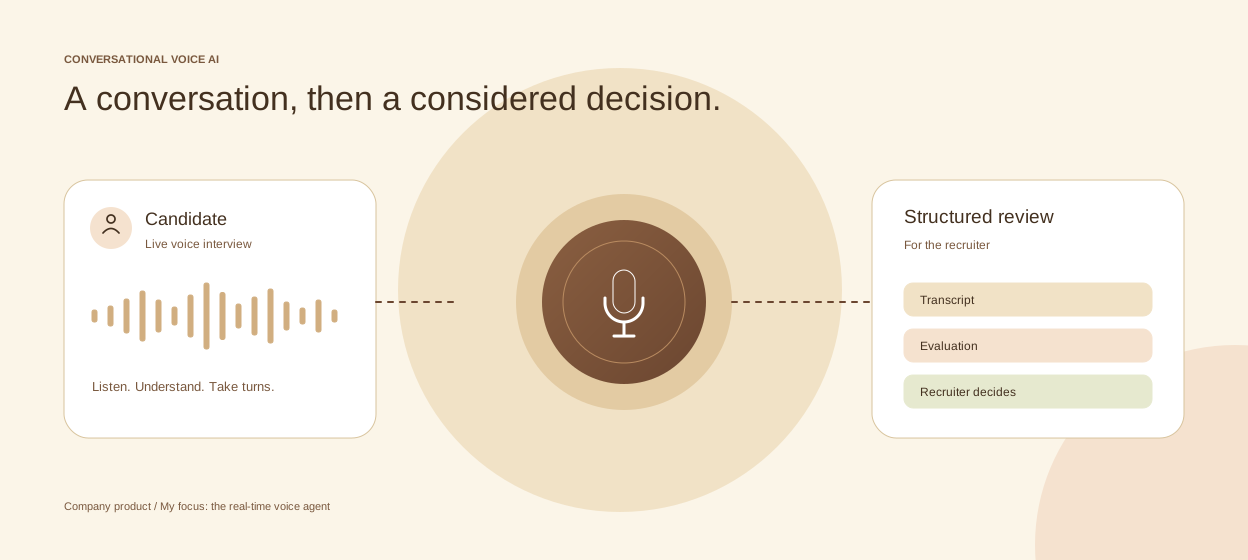
The platform takes hiring from a pile of applications to a short, structured review. It parses résumés and the job description, runs a live voice interview with each candidate, and produces a report. The recruiter makes the hiring decision; the platform's job is to make that decision quick and well-informed.
Pipeline overview. The last step is always a person.
This is a proprietary IoTides product, so this page covers the problems, approach and my contribution, not internal architecture, vendors or figures.
Résumé/JD parsing, the ATS and the wider product are team efforts at IoTides.
The first version was a hand-built prototype. It proved an AI could hold a live interview, and showed that a home-grown real-time layer wouldn't hold up at production scale: media transport, reconnection, turn-taking and concurrency were all being reinvented.
A research pass into how production voice AI is built led to re-platforming the session onto purpose-built real-time infrastructure. After that, effort went into the conversation itself instead of keeping the plumbing alive.
An interview is only credible if the agent lets the candidate finish and hears the answer correctly. Most of the tuning went into that:
“It feels slow” isn't a bug report. Every conversation turn is timed stage by stage, so the silence between a candidate finishing and the agent replying can be traced to a specific stage instead of guessed at.
That breakdown showed where the delay actually came from, which is what made it fixable: the changes it guided reduced the pause between turns. The same per-turn data also surfaces failures that are invisible from the outside, so they're caught in logs rather than in a candidate's interview.
Each interview is recorded, with handling for interrupted and stalled recordings so a failure is detected rather than silent.
AI models sit behind one interface, so changing a model is a configuration change.
Concurrent sessions were load-tested so limits are known before they're hit in a real interview.